

“Get the education you need before things become a crisis,” answers Andrea Paquette — president and co-founder of the Stigma-Free Society — when asked what employers can do to prevent employee mental health crises.
Spotting signs of staff distress and knowing the best ways to intervene are crucial to destigmatizing mental illness and preventing emergencies in the workplace. Plus, being proactive about mental health benefits the individual and the organization in many other ways.
The first step to happier employees and a healthier organization is to understand the signs of employee distress:
- Changes in appearance
- Changes in behavior
- Changes in mood
- Changes in cognitive abilities
Let’s explore these signs in more detail. Then, we’ll find out why and how organizational leaders should intervene.
What are the signs of employee distress?
The American Psychiatric Association’s Center for Workplace Mental Health notes that “warning signs for specific mental disorders will vary based on each disorder’s unique set of symptoms.” Even so, “employers should be aware of the general types of changes that could signal someone is struggling with their mental health.”
Differences in Appearance
Ask yourself…
- Does the person’s energy level look markedly different? Are they more fatigued and have lower energy than usual? Or, are they unusually energetic and excitable?
- Do they appear to have had an excessive fluctuation in weight over a short period of time?
- Does their personal hygiene seem different? Are they taking less interest in their presentation than they used to?
- Are they exhibiting nervous movements or frequent fidgeting?
Differences in Behavior
Is the person…
- Becoming withdrawn or avoiding social situations? Or are they abnormally talkative and in need of attention?
- Avoiding activities that they’d normally enjoy?
- Misusing substances? Or behaving as though intoxicated?
- Missing deadlines or turning in lower quality work than what’s normal for them?
- Showing up late to work or disappearing for extended amounts of time?
- Complaining of physical symptoms that seem uncommon for them?
Differences in Mood
Is the person…
- More irritable or aggressive than usual?
- Abnormally anxious or worried?
- Experiencing intense moods, like being overly energetic and excited, or unusually sad and quiet?
- Easily overwhelmed and unable to cope with challenges they normally take in stride?
- Expressing a feeling of hopelessness?
Differences in Cognitive Abilities
Is the person…
- Becoming easily confused?
- Having problems focusing or paying attention?
- Expressing a struggle with obsessive thoughts they can’t stop thinking about?
- Expressing persistently negative thoughts?
- Overly personalizing situations, like blaming themselves for things that go wrong?
What to Do When You See the Signs
**If you see someone in a potentially life-threatening mental health crisis, call 911, go to the nearest emergency room, or call the National Suicide & Crisis Lifeline at 988.**
Mental health advocate and founder of StigmaZero, Jason Finucan, tells Champions of Wellness that “what is lacking is the ability to speak freely about mental illness in the workplace without fear of discrimination or reprisals.”
This being the case in many workplaces, it’s essential to take an approach of empathy and kindness when addressing mental health struggles. Try your best to make the person feel safe and reassure them that they won’t be reprimanded if they need to talk about mental illness.
Lead with Empathy & Kindness
If you were in their situation, what would you want someone to do for you? Any amount of accusatory language (e.g., “your work has been below standard,” or “you’re distracting others during meetings”) will likely make the person defensive. Remember: They are not the problem. The changes in their appearance, behavior, mood, and/or cognitive abilities are symptoms of something bigger. The person isn’t choosing to experience the symptoms.
“I always say to people if you’re with somebody who’s behaving differently and it’s noticeable and it lasts more than a day or two, it’s never bad to sit down with that person and say ‘I’ve noticed that you aren’t yourself. Is there anything I can do to help?’,” advises Finucan. “Finding language that is inclusive and educational and non-threatening is important.”
Offer Support
Offering support to someone who may be experiencing a mental health crisis can be as simple as sitting down and talking with them. You could also guide them toward any resources your company provides or immediate CDC resources.
Some proactive ways to offer mental health support at work include…
- Understand the leading causes of employee burnout.
- Build a foundation of trust within your organization.
- Designate a team of wellness champions who employees can go to for support.
- Implement a wellness initiative tailored to your staff and their specific needs.
- Combat stigma by openly talking about the importance of taking care of your mental health.
Why does emotional well-being at work matter?
It’s becoming more understood by organizations that staff mental health needs to be prioritized. Finucan points out that “more and more companies, when I speak to them, they already know there’s a need to invest in education around mental health in the workplace. And they’re now just trying to figure out what’s the best way forward.”
Bottom Line
Most organizations understand that employee well-being impacts their bottom line. However, Finucan says the reason might surprise some leaders:
“What we found was the vast majority of the actual return on investment — people think it’s a reduction in absenteeism due to mental illness, but that’s not where the largest drain on profits is occurring. It’s actually in presenteeism which is tied to stigma.”
In other words, employees often attempt to continue working, even when they’re struggling with mental health stressors. Because of the outward and internalized stigma around mental illness, they feel compelled to show up to work. But that’s when, as Finucan notes, productivity really takes a hit and burnout thrives.
It would be more beneficial to a company’s financial health if employees struggling with mental illness felt comfortable taking time off. Like with any other illness, trying to work while healing only exacerbates the symptoms and puts wellness further out of reach.
Reduce Burnout
The American Psychological Association defines “workplace burnout” as “an occupation-related syndrome resulting from chronic workplace stress that has not been successfully managed.”
As leaders work to destigmatize mental illness in the workplace, they may find that absenteeism increases in the first year. That’s because employees feel safe taking time off when they need to. This, in turn, helps to counter burnout. And when burnout is successfully prevented, employees are happier, healthier, and more productive.
What happens when employee mental health isn’t addressed?
After over 20 years in a highly successful advertising career, Erika Ferszt woke up one morning in 2015 with no vision in her right eye. She underwent days of intensive neurological tests in the hospital, from which came the verdict:
Too much stress.
In an interview with Champions of Wellness, Ferszt explains that even though she was an accomplished ad executive, this stress-related incident gave her a wake-up call to get out of the business. “The way stress impacts us is really systemic. One thing has a knock-on effect. The other has a knock-on effect. Therefore, my losing vision was ultimately related to my lifestyle and stress,” she says.
Once she recovered her vision, she left her job in advertising to pursue two years of post-grad studies in the Neuroscience of Mental Health and gain her Master’s in Science in Organizational & Behavioral Psychology. Her experience and education allowed her to develop a program and an app that helps professionals improve their mood during high-stress days.
While Ferszt was able to turn a scary event into something positive, most working people aren’t that fortunate. The National Institute of Mental Health estimated in 2023 that more than one in five adults live with a mental illness in the U.S. That’s roughly 59.3 million people. Out of that population, only about half of those people sought out mental health treatment in the previous year.
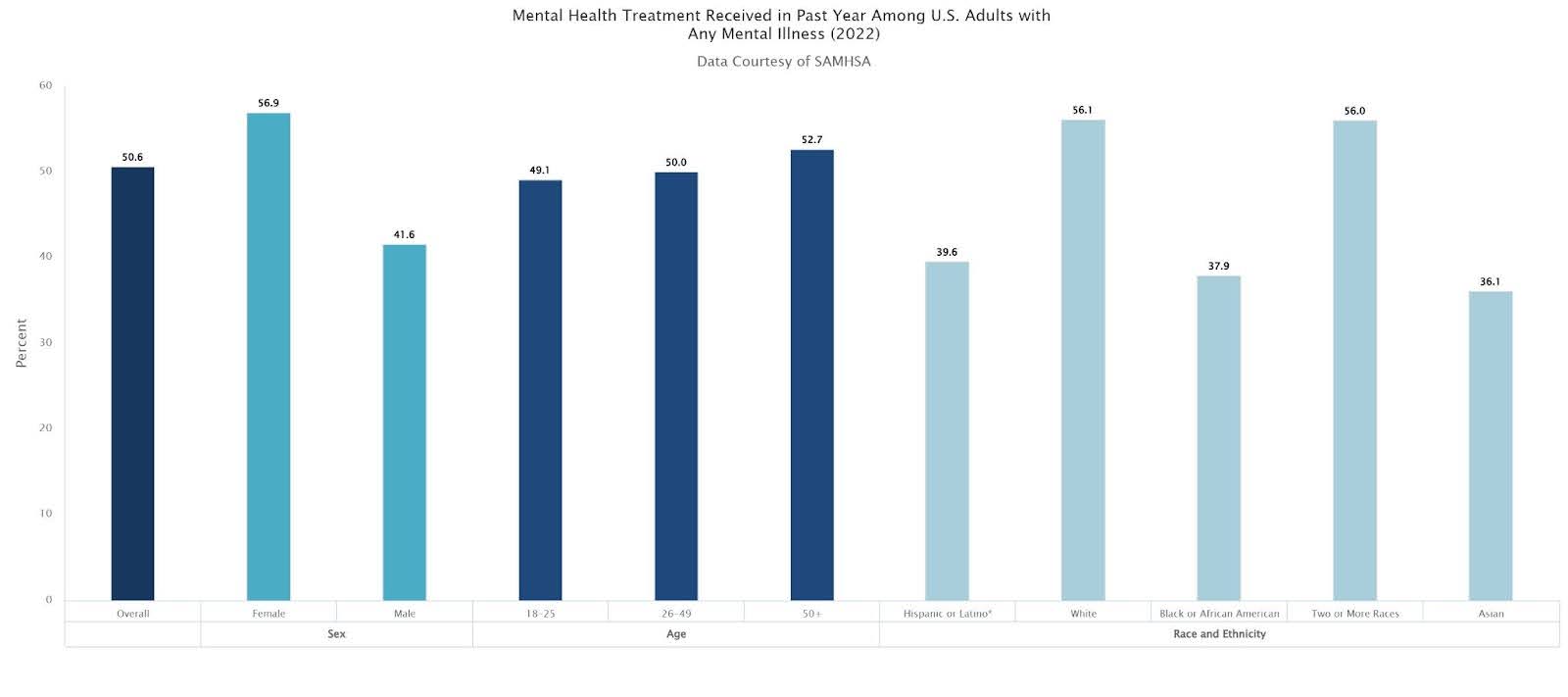
Chances are, you or someone you work with are living with a mental illness. There’s also a significant chance that the illness isn’t being treated with therapy or medication.
Finucan urges that mental illness — particularly in the workplace — should be taken as seriously as any other life-altering diagnosis. “What ending stigma in the workplace does is it allows people to react to mental illness the way we’re already reacting to any other illness that occurs,” he says. “All employers need to take responsibility for the health of their employees.”Are you interested in being proactive about your employees’ well-being before it’s too late? Connect with a Champions of Wellness Solutions Architect to clarify your challenges and map a practical path forward.