
The numbers are in from the State of Well-Being 2024-2025 report and healthcare employee distress has risen since 2023.
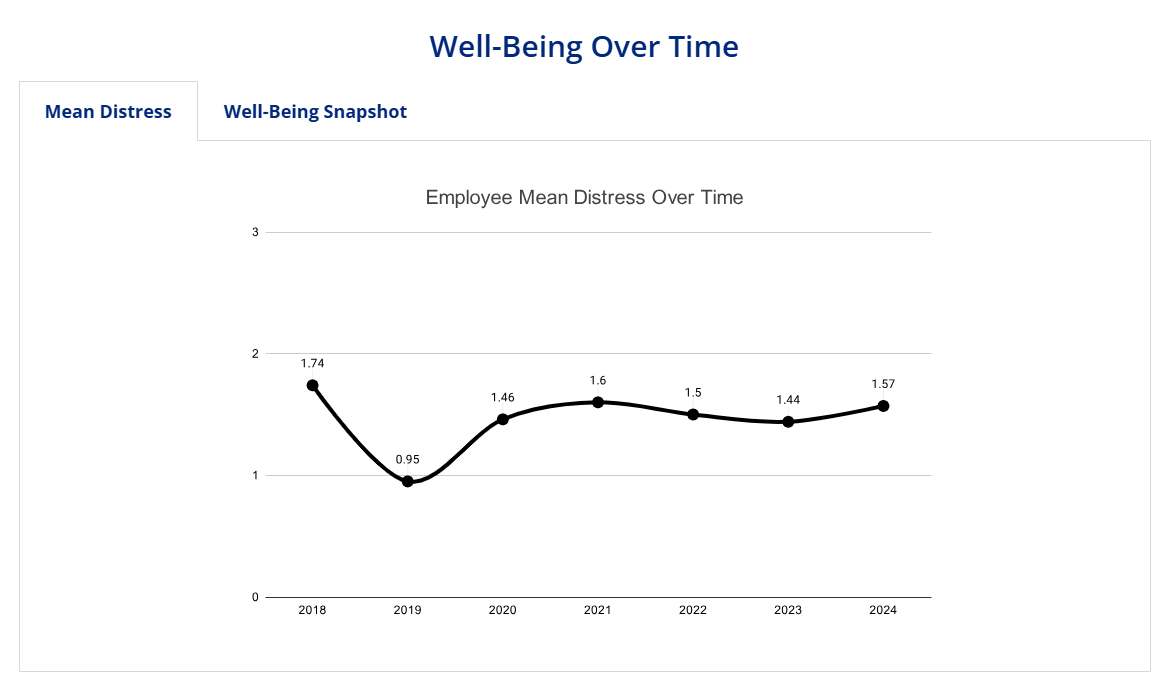
The 2024 Employee Mean Distress Score was calculated based on 25,500 Well-Being Index assessments. The full Mean Distress Score scale for employees ranges from -2 to 9. So, while distress remains relatively low on the larger scale, there still has been a marked increase from 2023 to 2024.
As a wellness leader in your organization, what do you do with this information? Perhaps your workplace’s employee well-being has taken a similar hit as the national scores have. Maybe you’ve found troubling hotspots of distress and aren’t sure how to align relief interventions with leadership’s overall objectives. The main question here is:
How do you transform employee wellness data into leadership decisions?
- Continuously and accurately collect anonymized employee wellness data.
- Identify specialties, occupations, or populations that need immediate support.
- Ask for employee feedback.
- Develop a tailored wellness intervention that aligns with organizational goals.
- Compare your organization’s statistics to the national scores.
Using employee statistics from the State of Well-Being 2024-2025 report, we’ll capture valuable insights and action items that you can apply to your own organization.
Let’s jump in.
Continuously Collect Anonymized Employee Wellness Data
The first step in making informed leadership decisions from employee wellness metrics is to get a baseline well-being score. Using the Mayo Clinic-invented and validated Well-Being Index is an effective way to collect anonymized wellness data for employees.
As you begin to introduce wellness initiatives to your staff, it’s crucial to continue tracking well-being metrics. Otherwise, it will be unclear which initiatives are working and which may need modifications.
For example, take the data collected over time for employees in the State of Well-Being report.
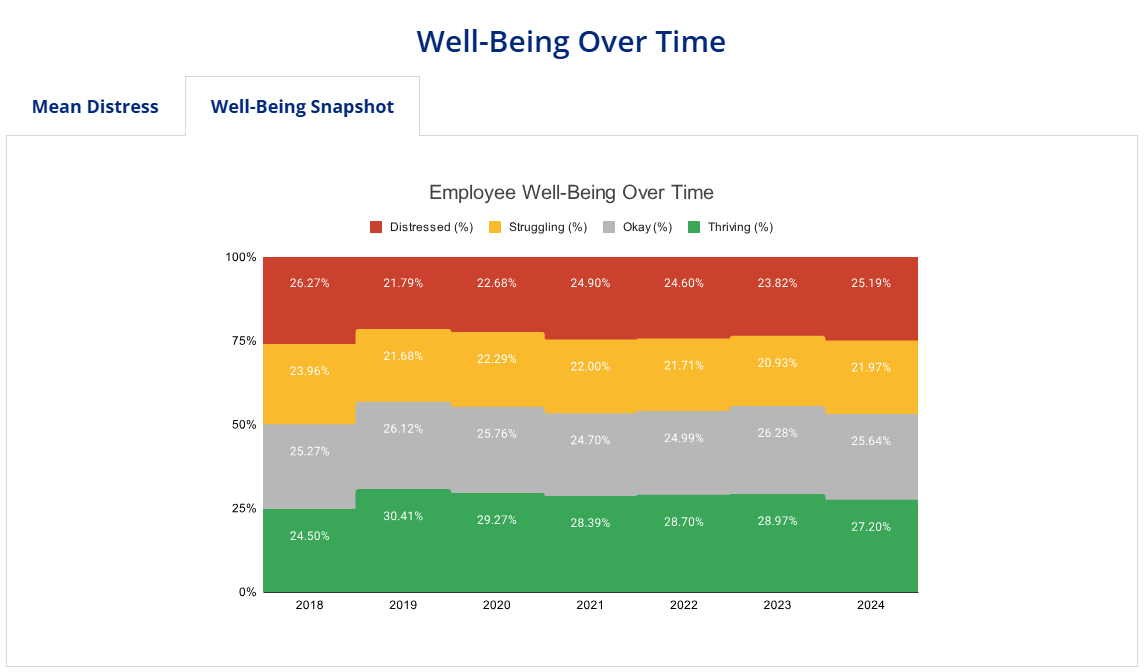
While this is national data, your organization’s Well-Being Snapshot is presented similarly within the Well-Being Index platform.
As you can see, Employee Well-Being Over Time aligns with the 2023 – 2024 increase in distress that the Mean Distress Score displays. Distressed participants increased by 1.37 percentage points from 2023 to 2024. Additionally, thriving participants decreased by 1.77 points.
If this were your organization’s Well-Being Snapshot*, you might decide to modify your wellness program based on increased distress year over year.
*Well-Being Index experts recommend assessing employee wellness more frequently than once a year.
You also might look back to the time between 2018 and 2019 in this case. What initiatives were you running that could’ve accounted for almost a 6% increase in thriving participants, as well as decreases in the distressed and struggling categories? Consider sourcing wellness program ideas from that time.
It’s also worth noting that distressed scores were lower throughout the height of the pandemic compared to 2024’s percentage. Did healthcare employees feel more support from institutions or their communities during that time? If this were your organization’s results, you might take into account what you were doing differently then compared to now.
Identify Populations that Need Immediate Support
The Well-Being Index can categorize scores by specialty, occupation, age group, and other demographic information. As far as the national statistics go, scores are split up by occupation here:
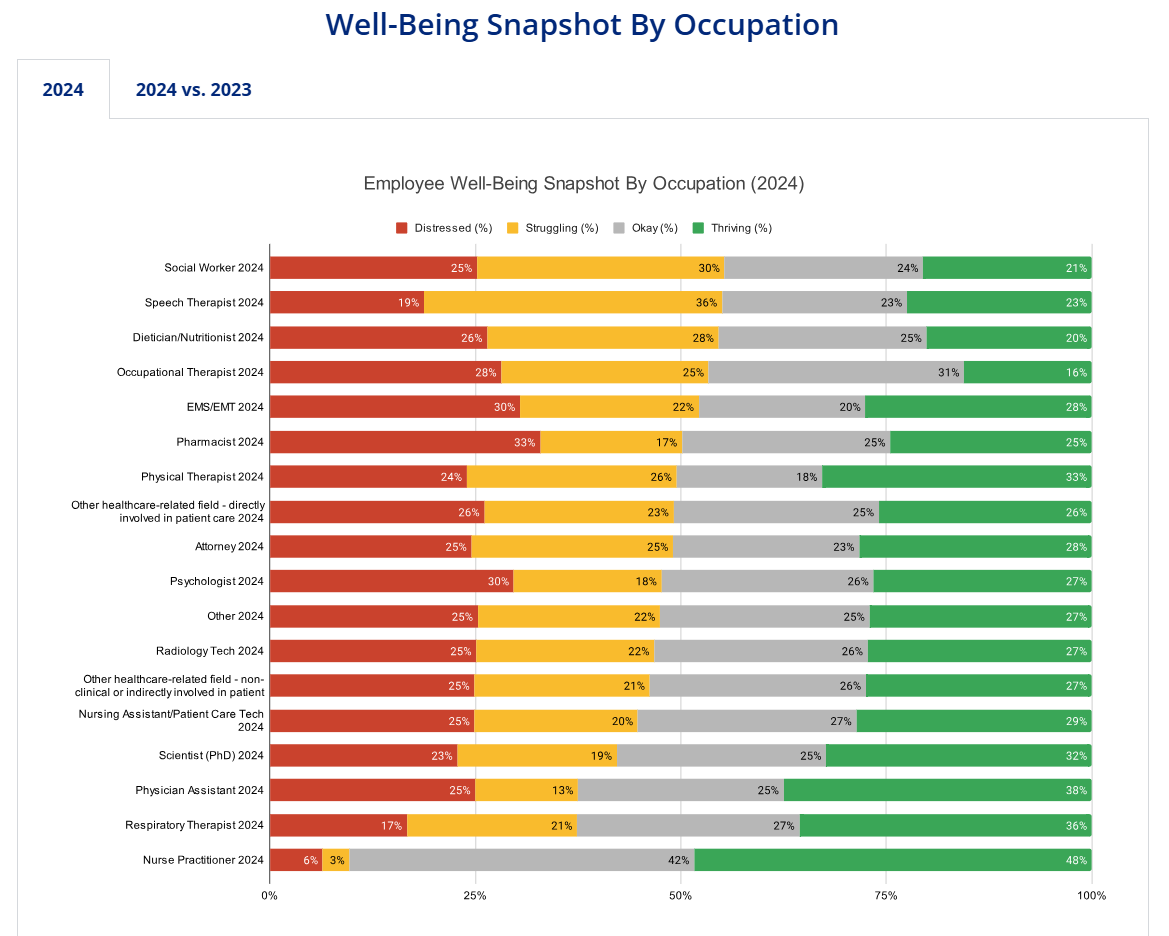
See Employee Well-Being Snapshot By Occupation 2024 vs. 2023 here.
To make informed decisions about employee wellness, it’s imperative that leaders identify the groups in need of the most support. If this were your organization’s results, you’d want to figure out why Pharmacists, EMS/EMTs, and Psychologists are leading in distress. You might look at the least thriving groups, Occupational Therapists and Dieticians/Nutritionists, too.
Once you identify the groups that need immediate support, one of the simplest and most effective ways to uncover sources of distress is to just ask.
Ask for Employee Feedback
Opening up communication about well-being is the most effective way of pinpointing causes of distress. This means that employees need to feel safe coming to their leaders with their concerns.
There needs to be a bridge of trust between employees and leadership.
As a wellness leader, you can cultivate a bridge of trust and open communication by…
- Encouraging a culture of care: Conduct regular check-ins, wellness assessments, and open forums for discussion. Express your commitment to employee well-being by showing that you and other leaders care.
- Creating a supportive environment: Encourage regular touchbases between peers. Healthcare employees often benefit from talking and relating to others who have had similar experiences.
- Facilitating a continuous feedback loop: Seek out regular feedback from employees so you can make real-time adjustments to your wellness program.
- Acting on feedback: Asking for feedback doesn’t mean anything if leadership doesn’t take action. Show that employee feedback is valued and acted upon. Make sure to relay any changes or new initiatives that result from employee suggestions.
Constant communication built on a foundation of trust is the best way for leaders to understand the unique needs of employees.
[RELATED: Learn from Well-Being Index experts how to build a foundation of trust in your organization.]
Develop a Tailored Wellness Intervention Aligned with Organizational Goals
You have the metrics, you’ve identified who’s most in need, and you’ve collected employee feedback. Now, whether you’re updating your organization’s current wellness program or implementing a new one, it’s critical you align your plan with overall organizational goals.
More often than not, executive team goals come back to finances. Therefore, when you’re mapping out a tailored wellness plan based on data and employee feedback, the bottom line has to be taken into account.
Michael Zgoda, MD, MBA, CPE and the wellness team at Dignity Health recognized that investing in employee well-being was the organization’s moral and financial responsibility. They turned to the Well-Being Index to assess the effectiveness of their program supporting the mental health of 80+ providers in the Department of Internal Medicine.
Here’s how Dr. Zgoda and his team aligned their wellness intervention with greater organizational objectives (i.e., financial goals):
- With the Well-Being Index, the team measured the department’s initial burnout rate at 57%.
- Burnout leads to a high risk for turnover, and turnover negatively impacts the bottom line. Dr. Zgoda’s team calculated their physician turnover rate at 13%.
- It was time to prove the financial case for investing in wellness support. Using the Cost of Burnout Calculator along with their validated measurement of physician burnout, historical turnover rates, and cost of onboarding new providers, the team discovered they were losing roughly 4 physicians annually to burnout, costing the organization about $1.9 million per year.
- Dr. Zgoda’s team was able to showcase the financial need for an evidence-based wellness program at Dignity Health. Alongside the Well-Being Index, they hired an organizational psychologist, launched a physician leadership intervention, developed a peer mentorship program, and improved system processes to maximize practice efficiency.
- After receiving leadership’s approval and implementing their wellness program, Dr. Zgoda’s team found that burnout and turnover decreased dramatically. They calculated savings of over $370K with a 210% return on investment per year.
Dr. Zgoda and the wellness team at Dignity Health didn’t stop measuring the financial impact of supporting employee mental health once their program kicked off. They continue measuring its effect on broader organizational goals to ensure long-lasting success for employees and the institution.
Compare Your Organization’s Numbers to the Nation
Another way to gain perspective on the well-being of your organization is to compare numbers with the national results.
Within the Well-Being Index platform, leaders and employees can see how their numbers compare to others across the country. This way, you can assess national trends to see if there are any hotspots your organization should be looking out for.
For a taste of what the Well-Being Index can offer, check out the State of Well-Being 2024-2025, a free report detailing the results from over 97,000 individual wellness assessments.
To learn more about how your organization can significantly decrease employee burnout and turnover, as well as transform employee wellness data into leadership decisions, reach out to an expert today.